Ai Li-Shan
The early post office envelopes were also issued in the horizontal format. The earliest date that I have found used was January 23, 1954. However, it is very possible that the issue could have been in late 1953. The purpose of the horizontal format was to supply the public with envelopes that could readily be used for printing, fig. 1 is one such envelope printed for the for the 10th Anniversary of the China Philatelic Society (it is still active today). These types of envelopes were used extensively for first day covers, especially the additional prints which many times do not have a cachet. This was the favorite envelope for philatelic covers during this period.
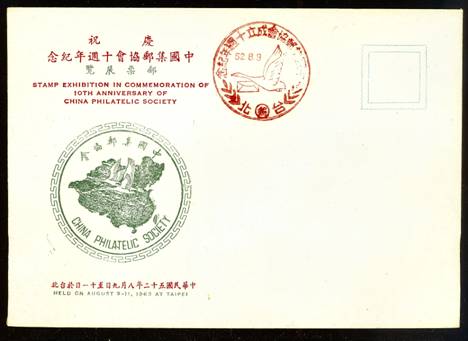
You will note the perforated box that appears in the upper right corner of the envelope. These vary also in size and design. However, they are usually covered by the stamps, so this characteristic is not considered in separating the envelopes.


Fig. 2 Fig. 3
There are two types of the character “Yu” found in the circle on the back, Type A is fig. 2 and Type B is fig. 3, the difference being that type A has the two boxes in the lower right of the character and type B has the single box.


Fig. 4 Fig. 5
There are also
two types of the Chinese inscription; Type 1 is fig. 4 with the right portion
of the characters read “dual style standard envelope, and Type 2 fig. 5, reads “western
style envelope”. Only the Type 1 is found on the earliest envelopes, later it
was changed to Type
The Chinese characters are measured left to right, including the circled “Yu”.
TYPE 1 CHINESE INSCRIPTION
Envelope
FE-1
49mm 15.5mm
9mm None
FE-2
49mm 15.5mm
9mm 114x162mm
FE-3 46mm 9mm
5.5mm 114x162mm
FE-4 40mm 9mm 5.5mm 114x162mm
FE-5 43.5mm 9mm 9mm 114x162mm
FE-1 Earliest date found January 21, 1954, light blue ink.
Paper: smooth cream color, .0061 inch thickness. Please note the first envelope does NOT have the 114x162mm envelope size imprinted on the back flap.
FE-2 Earliest date found July 18, 1955, dark green ink. (only envelope so far found with other than shades of blue).
Paper: smooth cream color, .0042 inch thickness.
a. Thin smooth better quality paper, white .0038 inch thickness.
FE-3 Earliest date found March 1957, dark blue ink.
Paper: smooth white paper, .0038 inch thickness
FE-4 Earliest date found May 1959, medium blue ink
Paper: rough white paper color, .0052 inch thickness. Please note the broken “Yu” in the circle, this may be on all envelopes from this printing or perhaps a variety. Fig. 6
FE-5 Earliest date found April 1960 medium blue ink
Paper: rough white paper, .0057 inch thickness
TYPE 2 CHINESE INSCRIPTION
Envelope
Number
Characters
Type A
Type B Imprinted
FE-6 43mm 9mm 5mm 114x162mm
FE-7
43mm 9mm 5.5mm 114x162mm
FE-8
45.5mm 9.5mm 5.5mm 114x162mm
53.5
2,000,000
FE-6 Earliest date found January 25, 1961 medium blue ink
Paper: smooth, cream color .0039 to .0045 inch thickness.
FE-7 Earliest date found November 8, 1961, very light blue ink
Paper: smooth, cream color .0045 inch thickness
FE-8 Earliest date found May 1966., medium blue ink.
Paper: smooth, cream color .0040-0045 inch thickness. This is the only envelope that has the date 53.5 (1964.5) and quantity imprinted. No doubt this envelope was used much earlier than the examples found.
a. with postal zone blocks added. The use of postal zone blocks was effective March 20, 1970. Fig. 6 is a cover used April 10, 1973 from a small postal agency. This was no doubt from residual stock that was overprinted for use after March 20, 1970 and being a small agency still had the envelopes on hand for sale.

Fig. 6